What “four generations” means
In our family, embroidery has been practiced across four generations. Each generation received a skill that already existed before them, adapted it to their own working life, and decided whether to continue.
Learning by being around the work
Traditional family crafts are often learned in fragments. A child watches. Later they help. They learn how thread is prepared, how fabric is held, how mistakes are corrected. Formal lessons may come later, but familiarity begins much earlier.
A craft can survive and still change
Preservation does not mean freezing every product and motif. Materials, customers and livelihoods change. The deeper continuity is the manual knowledge: control of needle, thread, fabric, colour and patience.
Our mother's generation
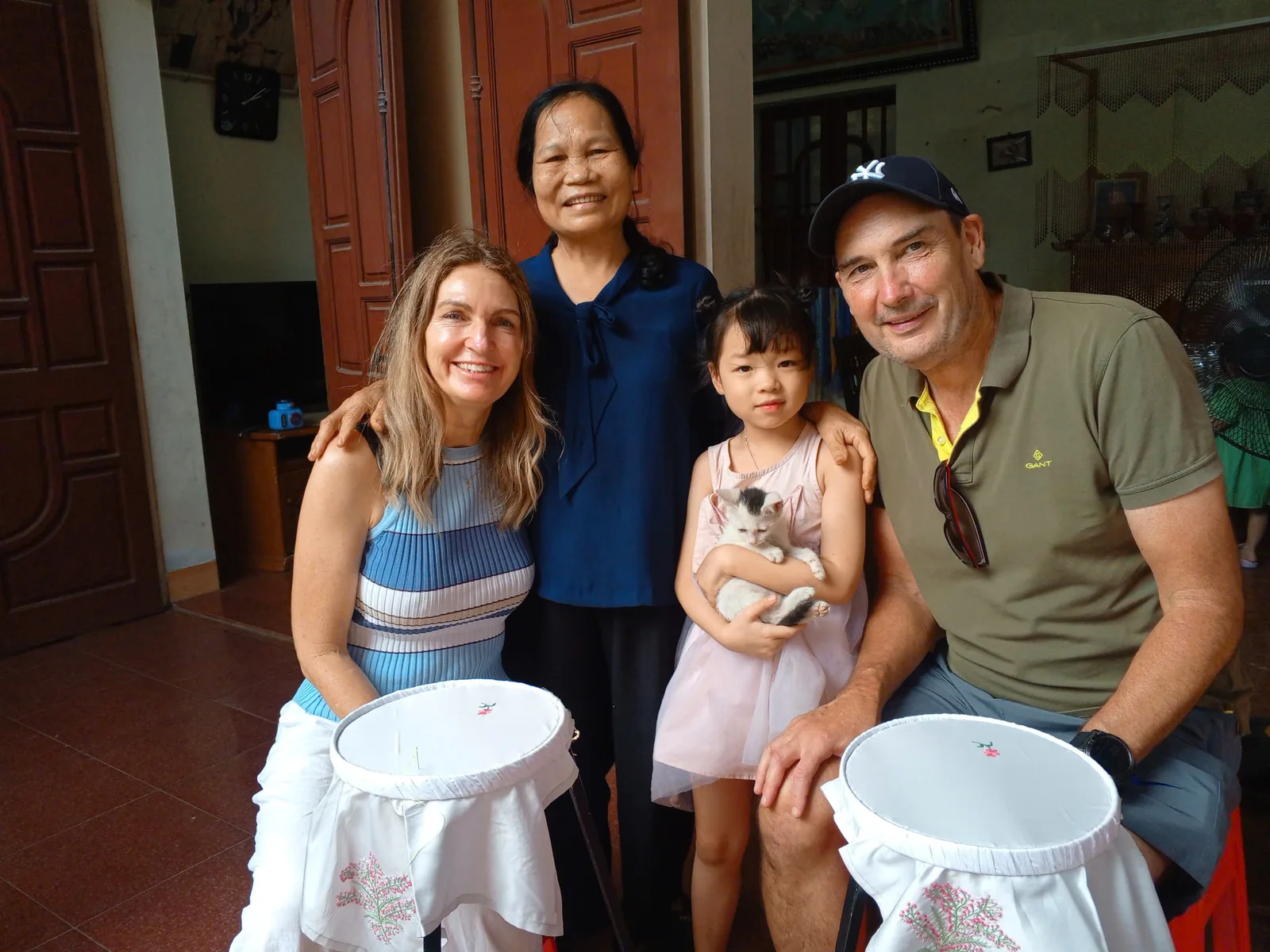
Dinh Thi Nguyen has practiced embroidery for more than 50 years. Her experience carries the accumulated habits of a lifetime: how to work efficiently, how to judge detail and how to stay patient with repetitive work.
The next generation
Today she is teaching our family again, including her youngest daughter. That matters to us because a title, certificate or framed artwork cannot replace the ability to actually do the craft.
Why we share this with travelers
Visitors give the tradition a new audience. A short workshop will not reproduce four generations of knowledge, but it can create respect for the time behind handmade work and give the next generation a reason to keep practicing.
Why generational knowledge is fragile
A skill can disappear in a single generation if nobody has the time, income or interest to learn it deeply. Written instructions help, but many details are tactile: how tight the fabric feels, how hard to pull, when a colour transition looks wrong. Those things are easier to learn beside another person.
Teaching is also a form of adaptation
The way one generation learns may not suit the next. Today, photographs, videos, visitors and workshops create new ways to explain techniques. Using new tools does not necessarily weaken a traditional skill; sometimes it helps the skill travel farther.
What visitors become part of
A tourist workshop is not the same as family apprenticeship, but it can support the same ecosystem. Visitors create demand for handmade work, ask questions that encourage documentation and give younger family members a reason to learn how to explain the tradition internationally.
A family story, not a claim to represent everyone
Our experience is one family's story inside Van Lam. Other families have their own histories, techniques and paths through economic change. We share ours because it is what we know directly.