What is traditional Vietnamese hand embroidery?
Hand embroidery creates images or decorative patterns by passing thread through fabric one stitch at a time. The maker controls the direction, spacing, tension, colour and overlap of each stitch. Those choices determine how flat or dimensional the finished image appears.
A traditional craft in Vietnam
Embroidery has been practiced in different Vietnamese communities for generations. In Van Lam Village, beside Tam Coc, local historical tradition traces the craft to the Tran period in the 13th century and associates its introduction with Lady Tran Thi Dung.
How does an embroidered image begin?
1. Choose and transfer the design
A beginner usually starts with a simple flower, leaf, symbol or outline. The design is lightly drawn or transferred to fabric as a guide.
2. Stretch the fabric
The fabric is placed in a hoop or frame so the working area stays stable. Good tension helps the stitches sit cleanly without distorting the cloth.
3. Select thread and colour
Experienced embroiderers often use several related colours to create highlights and shadows. A section that looks “pink” from a distance may contain multiple shades.
4. Build the image stitch by stitch
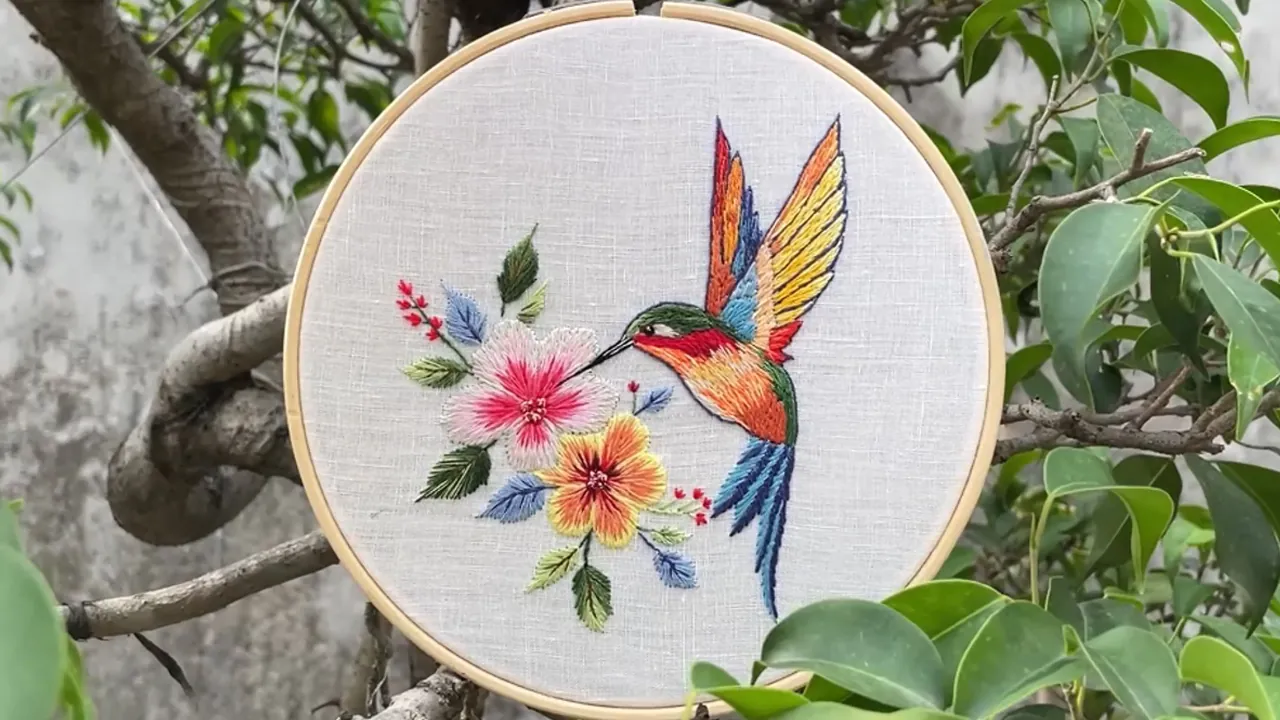
The needle passes through the fabric, across the surface and back again. Individual stitches become lines; lines become shapes; shapes become an image.
Why does hand embroidery take so long?
Time depends on size, detail, colour changes, stitch density and the embroiderer's experience. There is no single correct number. The important point is that every visible section is created manually, so complexity adds time quickly.
Hand embroidery and machine embroidery are different processes
A machine can repeat programmed stitches rapidly and consistently. With hand embroidery, a person controls each stitch. Small variations are part of the character of the work. Neither process needs to be insulted to explain the difference; they simply serve different purposes. Read our detailed hand vs machine embroidery comparison.
Why skilled embroidery is difficult
Putting a needle through fabric is easy. Controlling stitch direction, thread tension, colour transitions, density and the overall shape at the same time is harder. That control comes from repetition.
Can beginners try it?
Yes. A first workshop should use a manageable design and a few basic stitches. The goal is not to become an artisan in two hours. It is to understand the process well enough to appreciate what experienced hands can do.
Common stitches are only the beginning
Beginners often focus on stitch names, but experienced embroidery is less about collecting stitches and more about control. The same basic stitch can look very different depending on length, angle, spacing, thread thickness and how it overlaps the next colour.
How colour creates depth
Thread does not mix like wet paint, so colour transitions are built optically. The embroiderer places neighbouring shades beside and through one another. From close up you can see separate threads; from farther away the eye blends them into a smoother transition.
Why the back of the fabric matters
The back can reveal how the piece was constructed. It does not need to look identical to the front, but excessive knots, tangles and long uncontrolled jumps can make work bulky or fragile. Clean thread management is part of technical skill.
What subjects appear in Vietnamese embroidery?
Flowers, birds, rural scenes, landscapes, calligraphy, clothing decoration and portraits can all appear. There is no single motif that defines all Vietnamese embroidery. Regional traditions, market demand and individual makers influence what is produced.
How to recognize skill without being an expert
- Look for controlled edges rather than accidental gaps.
- Check whether stitch direction helps describe the form.
- Notice transitions between colours.
- Compare dense and delicate areas.
- Ask how long the maker has practiced and how the piece was planned.
Why trying it yourself changes the way you look
Before you embroider, a finished picture can look like “thread on cloth.” After struggling to keep ten simple stitches even, you begin to see the decisions behind a complex piece. That change in attention is one of the strongest reasons to join a beginner workshop.